Wild rice vs Black Beans: How To Choose?

Written by Dennis Gillett, Health & Fitness Writer. Updated on February 18, 2023.
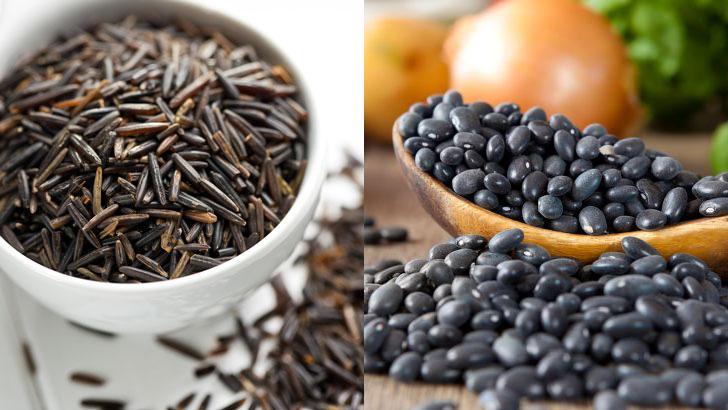
Although wild rice and black beans belong to different food groups, while wild rice belong is a grain, and black beans belong to legumes food group, and it’s not that common to compare foods from different groups, people are often interested in these comparisons as well.
That’s why we decided to create an in-depth article that compares wild rice and black beans, their nutritional values, similarities, differences, macronutrients, and micronutrients – vitamins and minerals.
Generally speaking, foods from grains and legume food groups are both high in carbs and protein and valuable addition to a plant-based diet.
Now, let’s see how wild rice and black beans compare specifically.
Wild rice
Wild rice (Zizania aquatica) is a type of cereal grain that is native to North America, specifically the Great Lakes region and the St. Lawrence River area.
It is a good source of carbohydrates, dietary fibers, and small amounts of vitamins and minerals like zinc, iron, and B vitamins. It is also rich in antioxidants and protein, making it a valuable food for vegetarians and vegans.
Wild rice has a nutty and slightly earthy flavor and is often used as a side dish or as an ingredient in salads, soups, and stuffings. It is also gluten-free and easy to digest, making it a great option for people with gluten sensitivities or celiac disease.
Wild rice is considered a functional food, as it has been shown to positively impact health when consumed regularly as part of a balanced diet. It is also considered a sustainable crop, as it can be grown in various habitats, including shallow water, and doesn’t require chemical fertilizers or pesticides.
Wild rice is an excellent source of Vitamin B3 (Niacin).
It also contains a good amount of Vitamin B1 (Thiamine), Vitamin B2 (Riboflavin), Vitamin B5 (Pantothenic acid), Vitamin B6 (Pyroxidine), and Vitamin B9 (Folate) and some Vitamin E.
Black Beans
Black beans (Phaseolus vulgaris) are a type of legume that are native to Central and South America.
They are a popular ingredient in many vegan and vegetarian dishes due to their high protein and fiber content and rich, nutty flavor.
Black beans are also a good source of antioxidants. They have been shown to have a number of potential health benefits, including reducing the risk of certain types of cancer and helping to lower cholesterol levels.
They are easy to incorporate into a wide range of recipes and can be enjoyed in dishes such as black bean soup, burritos, and salads.
Black Beans are an excellent source of Vitamin B1 (Thiamine), and Vitamin B9 (Folate).
They also contain a good amount of Vitamin B2 (Riboflavin), Vitamin B3 (Niacin), Vitamin B5 (Pantothenic acid), and Vitamin B6 (Pyroxidine) and some Vitamin K.
Wild rice vs Black Beans Nutrition
Now that we’ve described the origin, taste, and usage of these foods, we can move to the most interesting part – comparing wild rice vs black beans.
This comparison will start by comparing the caloric value of wild rice and black beans and their macronutrients and then go more in-depth by analyzing their vitamin and mineral content.
| Wild rice | Black Beans | |
|---|---|---|
| Energy | 357 kcal | 341 kcal |
| Carbs | 74.9 g | 62.4 g |
| Sugar | 2.5 g | 2.12 g |
| Fiber | 6.2 g | 15.5 g |
| Protein | 14.7 g | 21.6 g |
| Fat | 1.08 g | 1.42 g |
| Saturated Fat | 0.156 g | 0.366 g |
Wild rice vs Black Beans Calories
Most calories in raw grains and legumes come from carbs. Peanuts are an exception here, but they are often considered a nut instead of a legume because of their nutritional profile.
Comparing black beans vs wild rice for weight loss, black beans are slightly lower in calories, with 341 calories per 100 grams, compared to 357 calories per 100 grams of wild rice.
However, both wild rice and black beans can and should be a part of a healthy diet, and neither one shouldn’t be avoided if you’re looking to lose weight.
Wild rice vs Black Beans Protein
Legumes and most legume products, including wild rice and black beans, are important sources of plant-based protein.
Black Beans offer around 32% more protein than wild rice.
Black Beans have 21.6 grams of protein per 100 grams, while wild rice has 14.7 grams of protein per 100 grams.
Wild rice vs Black Beans Carbs
Counting carbs can be important for some people for different reasons, including blood sugar control, weight management, or athletic performance.
It’s also important for people on a keto diet, so let’s compare the carbs content in wild rice and black beans.
The total amount of carbohydrates is around 17% higher in wild rice than in black beans. It have 74.9 grams per 100 grams, compared to 62.4 grams in black beans.
There’s less sugar in black beans than in wild rice, 14% precisely.
One handful of black beans (28 grams) contains 0.6 grams of sugar, while the same amount of wild rice contains 0.7 grams.
Lastly, let’s take a look at the dietary fiber in wild rice and black beans.
Dietary fiber keeps the digestive system healthy and helps with weight management by promoting a sense of fullness.
With 4.3 grams of fiber per portion, black beans are a better source of fiber than wild rice which offer 1.7 grams per portion.
Wild rice vs Black Beans Fats
Like most other grains and legumes, with the exception of lupins and peanuts, wild rice and black beans are low in fat.
Fats in wild rice and black beans are mostly healthy unsaturated fats. They are naturally cholesterol-free and trans-fat-free.
Total fat in wild rice and black beans:
- Wild rice: 1.1 grams per 100 grams
- Black Beans: 1.4 per 100 grams
Speaking of saturated fats, wild rice is 50% lower in saturated fats.
Wild rice and black beans contain 0.2 grams and 0.4 grams of saturated fat per 100 grams, respectively.
Wild rice vs Black Beans Vitamins Content
This section will discuss the vitamin content of wild rice and black beans.
Vitamins are micronutrients, meaning we need only a small amount. However, they are very important for many processes in our bodies.
Wild rice has a higher amount of vitamin B1 (Thiamine), vitamin B9 (Folate), and vitamin K.
However, black beans have a higher amount of vitamin A, vitamin B2 (Riboflavin), vitamin B3 (Niacin), vitamin B5 (Pantothenic acid), vitamin B6 (Pyroxidine), and vitamin E.
Wild rice and black beans contain the same amount of vitamin C, vitamin D, and vitamin B12 (Cobalamin).
The following table shows the exact amount of vitamins wild rice and black beans contain side by side, so you can easily compare them.
| Wild rice | Black Beans | |
|---|---|---|
| Vitamin A | 19 IU | 17 IU |
| Vitamin C | 0 | 0 |
| Vitamin D | 0 | 0 |
| Vitamin B1 (Thiamine) | 0.115 mg | 0.9 mg |
| Vitamin B2 (Riboflavin) | 0.262 mg | 0.193 mg |
| Vitamin B3 (Niacin) | 6.73 mg | 1.96 mg |
| Vitamin B5 (Pantothenic acid) | 1.07 mg | 0.899 mg |
| Vitamin B6 (Pyroxidine) | 0.391 mg | 0.286 mg |
| Vitamin B9 (Folate) | 95 µg | 444 µg |
| Vitamin B12 (Cobalamin) | 0 | 0 |
| Vitamin E | 0.82 mg | 0.21 mg |
| Vitamin K | 1.9 µg | 5.6 µg |
Wild rice vs Black Beans Minerals Content
Minerals are important for our body to function properly. We need only a small amount of minerals, so they are called micronutrients.
Some minerals, like iron, calcium, zinc or, iodine, are relatively hard to get on a plant-based diet, so it’s important to choose your foods thoughtfully. This part of the wild rice and black beans comparison focuses on their mineral content.
Wild rice is a better source of calcium, copper, iron, potassium, and selenium than black beans.
On the other hand, black beans are a higher amount of magnesium, manganese, phosphorus, sodium, and zinc.
Wild rice and black beans contain the same amount of fluoride.
Check out the table below to learn how wild rice and black beans compare when it comes to mineral content.
| Wild rice | Black Beans | |
|---|---|---|
| Calcium | 21 mg | 123 mg |
| Copper | 0.524 mg | 0.841 mg |
| Fluoride | 0 | 0 |
| Iron | 1.96 mg | 5.02 mg |
| Magnesium | 177 mg | 171 mg |
| Manganese | 1.33 mg | 1.06 mg |
| Phosphorus | 433 mg | 352 mg |
| Potassium | 427 mg | 1480 mg |
| Selenium | 2.8 µg | 3.2 µg |
| Sodium | 7 mg | 5 mg |
| Zinc | 5.96 mg | 3.65 mg |
The Final Word
Wild rice and black beans are highly nutritious and a great addition to a plant-based diet.
Both wild rice and black beans are high in specific vitamins and minerals, and including them in your diet will give you the most benefits they offer.
Antioxidants found in grains and legumes can help to protect cells from damage and may reduce the risk of certain diseases and the effects of aging.
Additionally, the fiber and other nutrients in these foods can support the health of the digestive system and may even help to prevent certain digestive cancers.
Legumes and grains are a versatile food that can be incorporated into any meal of the day, including breakfast, lunch, or dinner. They can be served hot or cold, making them a convenient and tasty addition to a variety of dishes.
Holy Peas has strict sourcing guidelines and draws only from high-quality sources, including peer-reviewed studies, academic research institutions, and medical journals, associations and government institutions. Read more about our process.
- Wild rice Nutrients, U.S. Department of Agriculture, Agricultural Research Service https://fdc.nal.usda.gov/fdc-app.html#/food-details/167746/nutrients
-
Black Beans Nutrients, U.S. Department of Agriculture, Agricultural Research Service https://fdc.nal.usda.gov/fdc-app.html#/food-details/167746/nutrients
-
Listing of vitamins, Harvard Health Publishing, Harvard Medical School https://www.health.harvard.edu/staying-healthy/listing_of_vitamins/
-
Appendix 7. Nutritional goals for age-sex groups based on dietary reference intakes and Dietary Guidelines recommendations. (n.d.).
https://health.gov/dietaryguidelines/2015/guidelines/appendix-7/
-
International tables of glycemic index and glycemic load values 2021: a systematic review
https://academic.oup.com/ajcn/article/114/5/1625/6320814?login=false
-
Health Claim Notification for Saturated Fat, Cholesterol, and Trans Fat, and Reduced Risk of Heart Disease
https://www.fda.gov/food/food-labeling-nutrition/health-claim-notification-saturated-fat-cholesterol-and-trans-fat-and-reduced-risk-heart-disease
-
Nutrient Recommendations: Dietary Reference Intakes (DRI), Food and Nutrition Board of the National Academies of Sciences Engineering, and Medicine
https://ods.od.nih.gov/HealthInformation/nutrientrecommendations.aspx
-
Protein And Amino Acid Requirements In Human Nutrition, WHO
https://apps.who.int/iris/bitstream/handle/10665/43411/WHO_TRS_935_eng.pdf
-
Nutrition Facts Labeling RDIs Nutrients, U.S. Food and Drug Administration
https://www.fda.gov/media/99069/download
-
Nutrition Facts Labeling DRVs Food Components, U.S. Food and Drug Administration
https://www.fda.gov/media/99059/download
- It's written and or reviewed by an expert.
- We cite relevant studies and trusted sources.
- It's regularly updated.
Read more about our process and team.


